Is Your Novel Idea Good Enough? 8 Ways to Find Out
Before you spend months writing a novel, run your idea through this 8-step assessment to find out if it has what it takes.

Let's find out if your idea is actually ready.
Or maybe you have too many ideas, and you have no idea which one to commit to. Either way, you're in the right place.
I'm Leslie, an Author Accelerator certified book coach. I help fiction writers assess their ideas before they invest serious time into a story that isn't quite there yet. The goal isn't to talk you out of writing, it's to make sure that when you sit down to write, you're building on a foundation that can actually hold a novel.
Run your idea through these eight questions and see how it holds up.
1. Gut check: Do you actually love this idea?
Start here, because everything else depends on it.
Writing a novel is a long-term commitment. You are going to spend a lot of time with this story and these characters through the exciting early days, the messy middle, and the hard moments when you'd rather do anything else. You have to feel genuinely excited about it.
Ask yourself: does the thought of writing this story energize you? Do you find yourself thinking about it when you're supposed to be doing other things? Do the characters feel alive in your head even before you've written a word?
If yes, that's a strong signal.
If you're on the fence, sit with that before moving forward. It could mean the idea needs more development. It could mean it's not the right project for you right now. Either way, if you're not passionate about the story, staying motivated through the inevitable hard stretches is going to be a real challenge.
2. Originality vs. familiarity: What makes yours stand out?
Your premise is probably not original. And that's completely fine.
Themes like love conquers all, power corrupts, and being true to yourself have been around forever. Genre conventions and familiar tropes exist because readers genuinely love them. In fact, when it comes to genre fiction, readers are actively looking for those familiar elements. Part of your job is studying your genre well enough to know what readers expect and enjoy.
The real question is: what makes your story stand out within that familiarity?
Think of it like an elevator pitch: my story is familiar because of X, but it's different and special because of Y. That Y could be your setting, your characters, the complexity of your plot, an unexpected tone, a structural choice, or a major twist.
If you can figure out what makes your idea distinct while still honoring what readers already love about your genre, you're on the right track.

3. Conflict and stakes: Is there enough tension?
Without conflict, your story has nowhere to go.
Every great novel has a core conflict at its center. Examples are a battle between good and evil, a deeply personal internal struggle, or a clash of values. Can you clearly identify yours?
Ask yourself: what does your protagonist want, and what is standing in their way? Is the obstacle genuinely difficult? Are things too easy for them? And what does your protagonist stand to lose if they fail?
Stakes are what keep readers invested. The higher and more personal the stakes, the more readers will care about the outcome. If your protagonist has nothing real to lose, the tension collapses.
Clear conflict plus meaningful stakes is one of the strongest foundations a story can have.
4. Strong characters: Do your people feel real?
Characters are the heart of any novel. Readers stay for plot…but they come back for people.
Start with your protagonist. Are they compelling? Do they have clear goals, visible flaws, and a growth arc that the story can actually support? Readers need to connect with them, whether that means rooting for them or loving to hate them.
Then look at your supporting cast. Strong secondary characters add dimension to your world and give your protagonist more to push against, which enriches everything. Are your characters diverse and multi-dimensional? Do they feel like real people with their own wants and contradictions, or do they exist mainly to serve the plot?
Well-developed characters do something that no amount of plot can replicate: they make readers feel like they know someone.
5. Marketability: Who is this story for?
This one makes some writers uncomfortable.
Thinking about marketability does not mean selling out or writing to trends. It means understanding who your story is for and what impact you want it to have. If you can't identify your ideal reader, your story is going to struggle to reach the people who would love it most.
Think about the genre your story fits into. Is it clearly defined? Does it have a natural home in a bookstore or library? These questions matter more if you're pursuing traditional publishing, where agents and editors need to know exactly where to place a book. They matter less if your goal is to write and self-publish something you love.
So before you feel icky about this step, take a moment to assess your actual goals:
Just want to write and self-publish? Do it. Absolutely do it.
Aiming for traditional publishing? Marketability is going to matter, so do your research.
Want your story to reach as many readers as possible? Knowing your audience is how you make that happen.
Being aware of what readers in your genre are responding to right now is not the same as chasing trends. It’s called being informed.
6. Scalability: Does this idea have enough engine?
Some ideas are perfectly suited to a short story or a novella. And there is nothing wrong with that. But if you're writing a novel, you need an idea with enough depth and complexity to sustain the whole journey.
Ask yourself: does your story have enough material? Is there room for subplots, world-building, and real character development? What is the story engine here, the propulsion that keeps things moving from beginning to end?
Also worth considering: does your world have potential for sequels or spin-offs? For genre fiction especially, an exciting, expandable world can be a real asset.
If your idea has genuine layers and your story engine is strong, it has what it takes to go the distance.

7. Feedback: What do other people think?
No writer works in a vacuum, and outside perspective is genuinely valuable at this stage.
Share your idea with trusted friends, fellow writers, or beta readers and pay attention to how they respond. Not just whether they say they like it, but what questions they ask, what excites them, and where they seem confused or disengaged.
If multiple people point out the same issue or ask the same question, take that into consideration. It's usually a signal that something needs more development.
That said, not all feedback carries equal weight. Be discerning. Take what resonates and leave what doesn't. The goal is to gather useful information, not to let other people write your book for you.
Constructive feedback at the idea stage is so much easier to act on than feedback after you've written 80,000 words.
8. Your commitment: Are you ready to see this through?
We started by asking if you love this idea. Now, after everything on this list, the final question is whether you're ready to commit to it.
Writing a novel takes time, energy, and a lot of dedication. Are you willing to see this idea through to the end, even when it gets hard? Inevitably, it will get hard. That's part of the process, not a sign that something is wrong.
Also consider your flexibility. Stories evolve as you write them. Characters take unexpected turns. Plots shift. Are you open to letting the idea grow and change, or are you so attached to a specific vision that any deviation would derail you?
Passion matters, and so does adaptability. If you've got both, you're ready.
So, how did your idea hold up?
If your idea held up through most of these questions, that's a great sign. If it came up short in a few places, that's useful information, not a reason to give up. Most ideas need development before they're ready, and knowing where the gaps are is exactly how you close them.
The goal is to build confidence in your idea before you get to the hard parts. Doing this assessment now will help future you!
Want to continue assessing your novel idea?
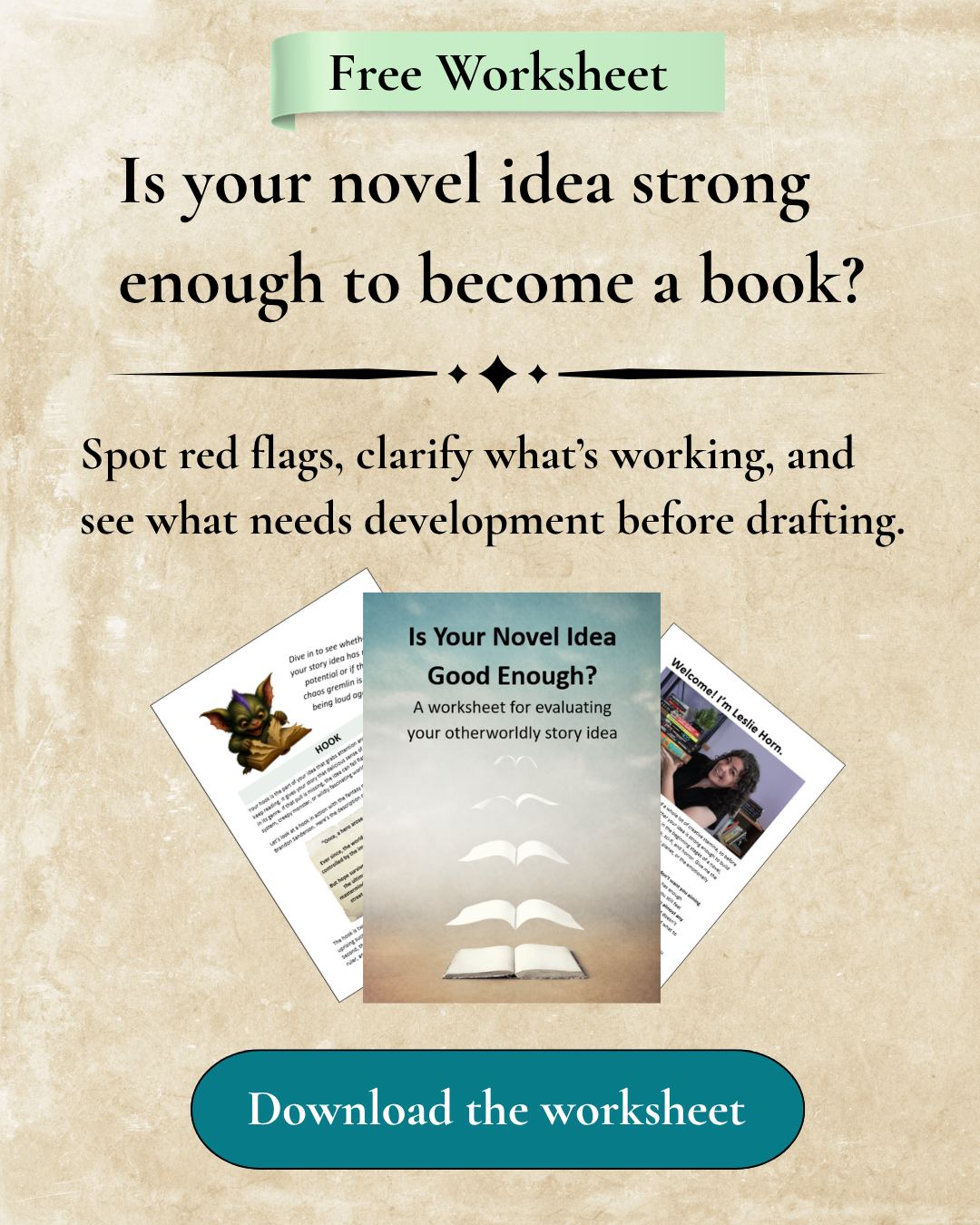
Want to take the work you did here even further? Is Your Novel Idea Good Enough is a practical, encouraging worksheet to help you evaluate whether your idea is strong enough to become a novel readers will love before you spend months drafting. You’ll spot red flags early, see what’s working, get clearer on what needs development, and test if you can stick with the idea long-term.
Happy Writing!
-Leslie
P.S. If you went through this whole list and still feel excited about your idea at the end, there’s your answer. Keep going.