Literary Terms Every Fiction Writer Should Know
You've probably heard terms like tone, symbolism, and motif thrown around. You might’ve had a general sense of what they mean, but not quite enough to use them confidently when talking about your own writing.
That's exactly what this post is for.
I'm Leslie, developmental editor and book coach, and I'm walking through some of the most useful literary terms for fiction writers, not as a vocabulary quiz, but as a practical guide to the tools that actually help you understand story, style, and craft. To make it more digestible, I've organized everything into three layers.
The language and style layer covers terms that shape how writing feels on the page. The meaning layer covers terms that help us talk about what a story represents. And the story craft layer covers terms that affect how a story is delivered to the reader.
Throughout, I'm pulling examples from some of my favorite books in fantasy, horror, and speculative fiction, because these terms are a lot easier to understand when you can see them in action.
Layer One: Language and style
These are the terms that shape how writing feels and sounds on the page.
Tone
Tone is the author's attitude toward the subject, the scene, or the characters being described. It's the emotional quality carried by the writing itself, and it shapes how prose comes across before the reader starts analyzing what it means. Writing can sound playful, detached, hopeful, warm, serious, ironic, or unsettling, and those choices all affect how we experience the story.
Mexican Gothic is a strong example of tone done intentionally. The writing establishes an eerie, unsettling atmosphere almost immediately. Not cozy or lighthearted, but decayed, ominous, and slightly poisoned. Something feels wrong beneath the surface before the story even fully explains what that something is. The descriptions, the atmosphere, and the emotional undertone of the language all carry this sense of unease. Tone isn’t just the events happening; it’s the attitude the writing brings to those events.
Mood
Tone and mood are closely connected but not the same thing.
Tone belongs to the page. It’s what the writing is doing. Mood belongs to the reader. It's the emotional atmosphere you experience as you move through the scene.
In Mexican Gothic, the mood starts as mystery, because both the character and the reader can sense something is wrong without fully understanding what’s wrong. As the story continues, that mystery transforms into unease, dread, and claustrophobic tension. You feel like the house is pressing in. You feel trapped alongside the character inside something that's hiding something rotten underneath.
The tone in Mexican Gothic is eerie and sinister. The mood that tone creates is one of growing dread.
Imagery
Imagery is descriptive language that creates a mental picture or appeals to the senses. Strong imagery doesn't tell you that a place is creepy or beautiful; it gives you details that let you experience that feeling for yourself.
Mexican Gothic uses the description of the house to do this really well.
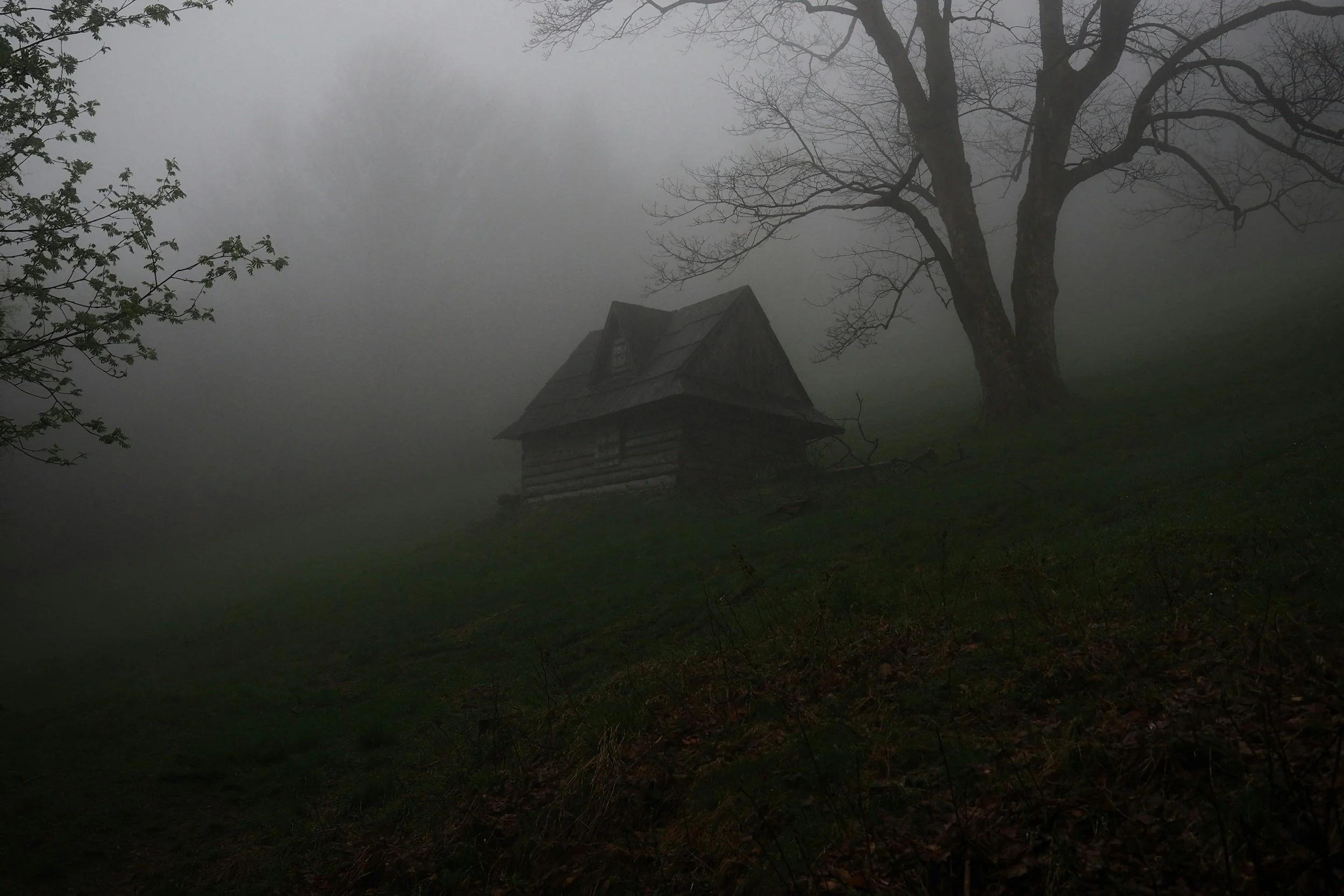
“It looked absolutely Victorian in construction, with its broken shingles, elaborate ornamentation, and dirty bay windows. The house loomed over them like a great quiet gargoyle. It might have been foreboding, evoking images of ghosts and haunted places, if it had not seemed so tired. The slats missing from a couple of shutters, the ebony porch groaning as they made their way up the steps to the door, which came complete with a silver knocker shaped like a fist dangling from a circle.”
Every detail creates a vivid sensory impression of age, neglect, and Gothic unease.
That's imagery working at its best. You can see the broken shingles and dirty windows. You can hear the groaning porch. And all of those concrete details add up to an emotional experience. The house feels haunted and oppressive before the story ever has to tell you to be afraid of it.
Simile and Metaphor
A simile is a comparison using the words "like" or "as." A metaphor makes the same kind of comparison but treats one thing as if it actually is another, without using those connector words.
From Mexican Gothic: the voices of certain characters are described as such:
“their voices were like the buzzing of insects.”
That's a simile, and notice how it does double the work. It helps you hear the voices, but it also makes them feel irritating, invasive, and unsettling. Similes often do this.
Turn that into a metaphor and it becomes:
“their voices were a swarm of buzzing insects.”
Now the comparison is more direct and immediate. Both tools are useful, but the choice between them often comes down to how much force you want the comparison to carry.

Layer Two: Meaning
These terms help us talk about what a story represents and what ideas it's exploring.
Allegory
Allegory is when a story operates on a larger representational level. When the narrative as a whole can be read as standing for bigger ideas, moral qualities, or social realities beyond the literal events on the page.
The Metamorphosis is a classic example. Gregor's transformation into an insect isn't only a bizarre plot event. It can be read as representing alienation, dehumanization, disability, or the way modern life reduces people to their usefulness. His family can no longer understand, accept, or value him once he's been transformed, and that exposes how quickly dignity and belonging can disappear when a person stops being seen as useful.
Theme
Theme is the central idea or message a story explores. Most novels have more than one theme, but usually one or two feel especially central to what the story is really wrestling with.
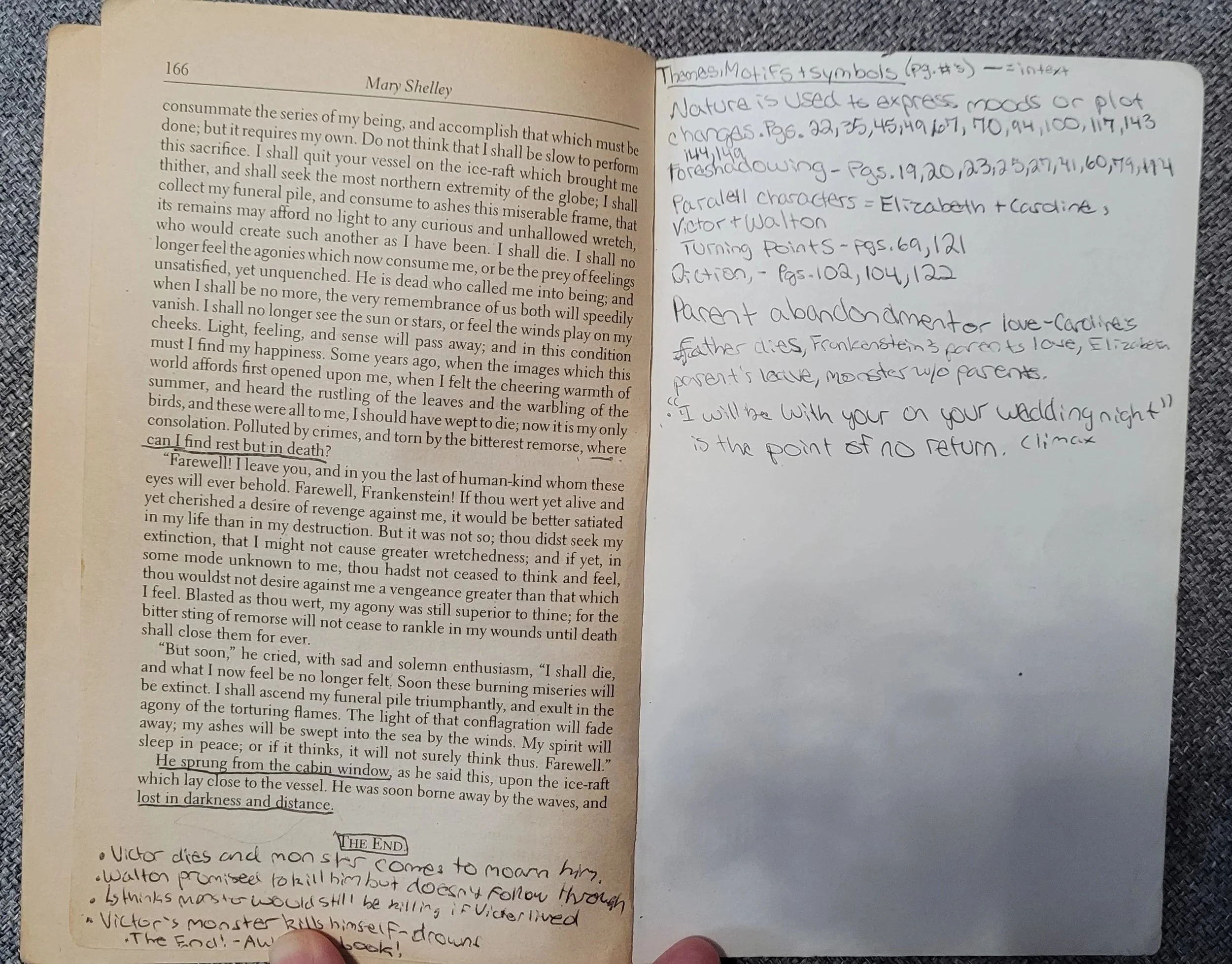
I want to use Frankenstein for this one. I actually still have my copy from high school English with all my notes in it, though I'll admit my annotations on theme and symbolism in the back are pretty sparse. Whoops.
The theme I'd point to in Frankenstein is:
The danger of pursuing knowledge or creation without responsibility.
Victor doesn't just want to understand the world, he wants power. He wants to unlock the secret of life itself. But the moment he succeeds, he abandons what he's made. He refuses to care for the creature, guide it, or take any accountability for its existence.
The destruction in the novel comes both from the act of creation and Victor's failure to take responsibility for the consequences of his own ambition. He wants the glory of discovery without the burden that comes with it. That choice destroys not just him, but the creature and everyone around them. It shows what happens when ambition is separated from responsibility.
Symbolism
Symbolism is when a person, object, or image represents a deeper meaning beyond its literal role in the story. A symbol still exists within the world of the book, but it also carries extra meaning that deepens the ideas the story is exploring.
In Frankenstein, ice is a strong example. It appears in the frozen, desolate landscapes that frame the novel, especially in the Arctic setting surrounding Victor's final pursuit of the creature. On a basic level, ice is simply the setting. But symbolically, it reinforces isolation, alienation, emotional coldness, and the loss of human connection. Victor ends up chasing the creature across the frozen north, and that landscape mirrors what his choices have done to him. He’s become cut off from family, companionship, and ordinary human life. The cold, barren environment reflects the loneliness and bleakness that now define him.
Motif
A motif is a recurring image, idea, or pattern that appears throughout a story and helps support its larger meaning. Unlike a symbol, which is often one object carrying deeper significance, a motif gains its power through repetition.
In Frankenstein, isolation is a strong motif. Victor isolates himself in his studies, cutting off from family and friendship to pursue his work. The creature is also isolated and rejected by society, denied companionship, treated as something outside humanity. Isolation keeps repeating, both as a choice and as a punishment, and that pattern connects directly to the novel's theme. Victor's isolation is part of what allows his ambition to become dangerous. No one is there to slow him down or hold him accountable. And the creature's forced loneliness becomes part of what drives the tragedy forward.
Layer Three: Story Craft
These are the terms that affect how a story is actually delivered to the reader.
Point of View (POV)
POV determines whose perspective the reader experiences the story through, whose eyes we're looking through, whose thoughts we're closest to, and what information we have access to at any given moment.
Mistborn is a great POV example. Even though it's written in third person, it stays close to Vin's perspective, especially early on. Vin is also learning how this world works. We discover the rules, the politics, the danger, and the magic system through what she notices and what she doesn't yet understand, which makes a huge, complex fantasy world feel discoverable rather than overwhelming.
Brandon Sanderson also shifts into other POVs occasionally, and he was deliberate about when to do that. He held back Elend's POV for a while specifically because keeping readers out of his head preserved uncertainty about his motives, which kept the tension centered on Vin's experience. He also notes that he sometimes uses an outside POV near the end of a book to show a moment differently or reveal something the main character's perspective couldn't show as effectively.
POV is a technical label, a tool for controlling mystery, emotional distance, and what kind of experience the reader has in any given scene.
Foreshadowing
Foreshadowing is a hint or clue about what's coming later in the story.
For Mistborn, Sanderson noted in his annotations that an early reference to northern mystics in Chapter 5 foreshadows the abilities of Keepers like Sazed, specifically their power to make themselves heavier or lighter. That payoff doesn't fully arrive until book two. Good foreshadowing plants something early that may not seem important at the time, but clicks into place later.
Flashback
A flashback is when the narrative jumps back in time to show an earlier event directly, not just a brief mention of the past, but an actual return to an earlier scene so the reader can experience it rather than just hear it summarized.
The Hero of Ages, the third Mistborn book, includes a flashback showing the day Clubs recruited a young Spook. It takes the narrative back to an earlier moment in order to reveal something emotionally important in the present, giving us more context for both characters and deepening our understanding of the bond between them.
That's the key thing to understand about flashbacks. They should do more than explain backstory. They should deepen character, shift our understanding of the present, or add emotional texture that matters to what's happening now.
Your Takeaway
Literary terms are not just school vocabulary. They're practical tools for fiction writers to help with reading more intentionally, revising more intentionally, and talking about your own work with a lot more clarity.
When you can identify what your prose is doing, what your story means, and how your narrative is being delivered, you become a more deliberate writer. And deliberate writing is almost always stronger writing.
Quick tip: Use your writing software’s find feature to quickly spot overused words, tighten your sentences, and make your writing stronger line by line. Search for those words using the free crutch words checklist!
Happy Writing!
-Leslie
P.S. If you find yourself rereading a scene and sensing something is off but not being able to name what, these terms are often exactly the vocabulary you needed. Knowing what to call something is the first step to fixing it.